
Alpha W, NRC and SAA: How to Compare Acoustic Ratings Correctly
Single-number acoustic ratings are useful, but only when they are understood in context. Comparing different rating systems directly can lead to the wrong specification decision.
NRC, SAA and Alpha W (αw) use different calculation methods and frequency ranges. A product with one rating should therefore not be compared directly with a product using another rating unless the same calculation method is applied to both.
Because every room behaves differently, acoustic privacy needs to be assessed in context. Through our Acoustic Advisory service, our in-house acoustic specialists review the room, its use and acoustic requirements, translating them into a clear strategy for the type, quantity and placement of acoustic treatment.
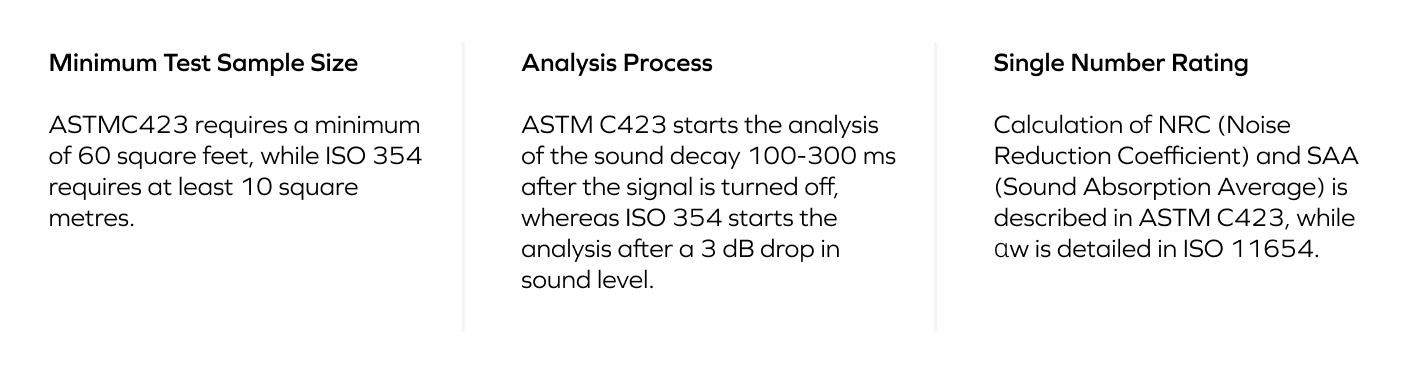
Sound absorption can be measured according to ASTM C423 or ISO 354. The standards are comparable in several ways, but they differ in sample-size requirements, analysis procedure and the single-number ratings they define.
ASTM C423 requires a minimum test sample of 60 square feet, while ISO 354 requires at least 10 square metres. ASTM C423 starts analysing sound decay 100-300 ms after the signal is switched off; ISO 354 starts after a 3 dB drop in sound level. NRC and SAA are described in ASTM C423, while αw is detailed in ISO 11654.
NRC, SAA and αw typically range from 0 to 1. A value close to 0 indicates a reflective surface; a value close to 1 indicates a highly absorptive surface. In practice, no commercial material is a perfect absorber or a perfect reflector.
The closer the rating is to 1, the stronger the sound absorption performance. The important point is to compare like with like: NRC with NRC, SAA with SAA and αw with αw.
NRC, or Noise Reduction Coefficient, evaluates absorption at four mid-range third-octave frequencies: 250, 500, 1000 and 2000 Hz. These frequencies sit within the speech frequency range, which is why NRC remains widely used in building acoustics.
Its limitation is that it averages only four data points. This can mask performance differences outside those selected frequencies. The source material notes that NRC is being phased out and replaced by SAA, although designers and acousticians still encounter it regularly.
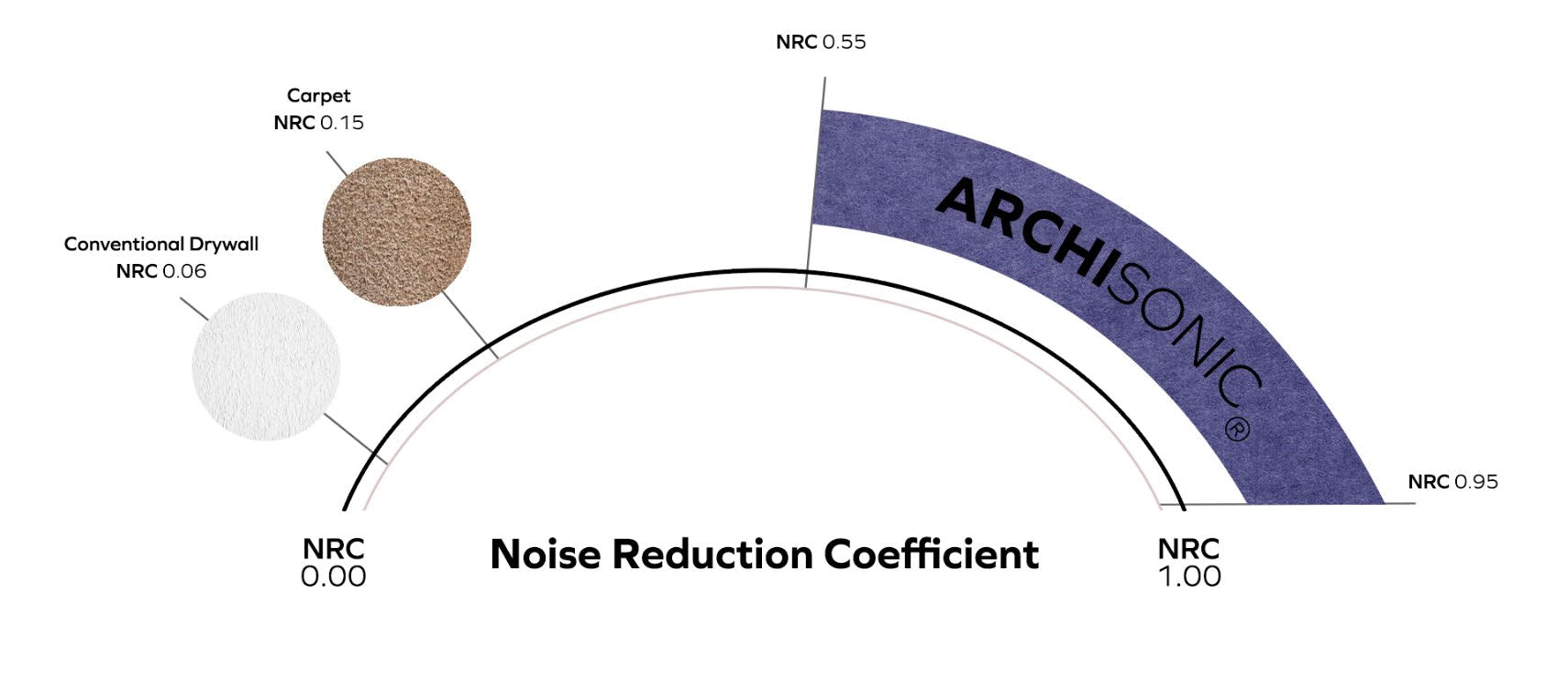
NRC is useful as a quick reference, but it is not the only way to describe acoustic absorption. SAA and Alpha W both provide a broader view of material performance, although they are calculated differently and should not be treated as interchangeable.
SAA, or Sound Absorption Average, is based on the absorption coefficients across 12 third-octave bands from 200 Hz to 2500 Hz, with the result rounded to the nearest 0.01. Because it includes more frequency points than NRC, SAA offers a more detailed single-number representation of a product’s absorption performance. It is a strong basis for comparison when SAA values are available for all products under review.
Alpha W, or αw, is the European reference-curve method defined in ISO 11654. Instead of averaging third-octave data, it compares a material’s absorption coefficients with a standard reference curve, which is adjusted in 0.05 steps until the sum of negative deviations is no more than 0.10. The adjusted value at 500 Hz becomes the αw rating. Where the material performs notably above the adjusted curve in a specific frequency range, a frequency-shape indicator can be added.
For specification, the important point is consistency: compare SAA with SAA and αw with αw. Both values can support more accurate product selection than an NRC-only comparison, provided the same metric is used across all products being assessed.
A biased comparison happens when one product is assessed using NRC and another is assessed using αw or SAA. The numbers may look similar, but the calculations behind them are not identical.
For reliable specification, use the same rating method for every product being compared and, where possible, review the full frequency data. This is especially important when a room has a specific acoustic challenge, such as speech clarity, reverberation control or low-frequency build-up.